Linked Lists in 15 Minutes !!!

Linked Lists : Linked lists are special list of some data elements linked to one another.

Each element pointing to the next element. Each element is called a node, which has two parts.

  1. INFO part which stores the information.
  2. POINTER which points to next element.

In singly linked list  nodes have one pointer pointing to the next node.

Doubly linked list nodes have two pointers prev and next. Prev points to the previous node and next node points to the next node in the list.

Advantages :

  1. Linked lists are dynamic data structure : They can grow or shrink during the execution of a program.
  2. Efficient memory utilization.
  3. Insertion and Deletion are easier and efficient.

Disadvantages :

  1. More memory require, if the number of elements are more.
  2. Accessing the data element is time consuming.

Key terms :

  1. Data Fields
  2. Link fields
  3. NULL pointer :  The link field of last node contains NULL.
  4. External Pointer :  it’s a pointer to the very first element.
  5. Empty list : If nodes are not present in lists.  START = NULL.

Representation of linear linked list

struct node
{
 int data;
 struct node *next;
 };
typedef struct node NODE;
NODE *start;

Operation on linked lists :

  1. Creation
  2. Insertion
  3. Deletion
  4. Traversing
  5. Searching
  6. Concatenation
  7. Display

Linked Lists creation and display code :

#include<iostream>
#include<conio.h>

using namespace std;

struct node
{
	int num;
	node *ptr;
};

typedef struct node NODE;

class LinkedList
{
	NODE *first, *head, *temp;
	int count, choice;
	
public :
	void insert();
	void output();
	LinkedList()
	{
		first = NULL;
		count = 0;
		choice = 1;
	}
};

void LinkedList::insert()
{
	while (choice)
	{
		head = new NODE;
		cout << "Enter the data Element" << endl;
		cin >> head->num;

		if (first != NULL)
		{
			temp->ptr = head;
			temp = head;
		}
		else
		{
			first = temp = head;
		}
		cout << " Do you want to continue : Type 1 or 0 " << endl;
		cin >> choice;
	}
}

void LinkedList::output()
{
	temp->ptr = NULL;
	temp = first;

	cout << "Linked Lists Display :: " << endl;

	while (temp != NULL)
	{
		cout << temp->num << endl;
		count++;
		temp = temp->ptr;
	}
	cout << "Number of items in Linked Lists ::  " << count << endl;
}
C++ Crack Code Notes !!!

Constructor initialization lists – C++ provides a way of initializing member variables that allows us to initialize member variables when they are created rather than afterwards. This is done through use of an initialization list.

class Something
{
private:
int m_nValue;
double m_dValue;
int *m_pnValue;

public:
Something() : m_nValue ( 0 ), m_dValue( 0.0 ), m_pnValue( 0 ) // A default constructor
{
}

Something(int nValue, double dValue, int *pnValue) : m_nValue ( nValue ), m_dValue( dValue ), m_pnValue( pnValue ) // A specific constructor
{
}
};

Composition :  

Life Changing Books… Must Read Before Die !!!

Books List :

  1. 7 Habits Of Highly Effective People – by Stephen R. Covey
  2. How to win friends & Influence people – Dale Carnegie
  3. Think and grow rich- Napolean Hill
  4. Awaken the giant within  – Anthony Robbin
  5. The greatest salesman in world –  OG Mandino
  6. Don’t Sweat the Small Stuff – Richard Carlson
  7. Drive – Daniel H. Pink
  8. The Power of Positive thinking – Norman Vincent
  9. As a Man Thinketh – by James Allen
  10. The War of Art by Steven Pressfield
  11. Turning Pro – by Steven Pressfiel
  12. Flow: The Psychology Of Optimal Experience – by Mihaly Csikszentmihaly

Continue….!!!

Linked List in 15 Minute!!

Definition : Linked list is a data structure used for sorting collection of data.

Properties :

  • Successive elements are connected by pointers.
  • Last element points to NULL.
  • Can grow and shrink in size during execution of a program.
  • Can be made just as long as required.
  • Its does not waste memory space.

Linked List Algorithm using C++ :

Heap Sort in 15 minute !

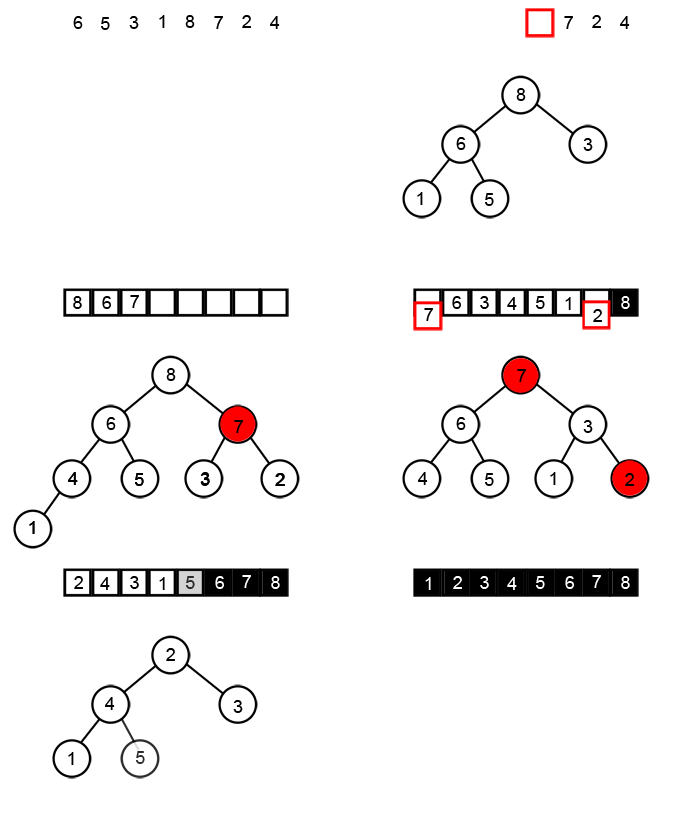
Definition : Heap sort is comparison based sorting algorithm based on Binary Heap data structure. It is similar to selection sort where we first find the maximum element and place the maximum element at the end. We repeat the same process for remaining element.

  • A Binary Heap is a Complete Binary Tree where items are stored in a special order such that value in a parent node is greater(or smaller) than the values in its two children nodes. The former is called as max heap and the latter is called min heap.
  • Binary Heap is a Complete Binary Tree, it can be easily represented as array and array based representation is space efficient. If the parent node is stored at index I, the left child can be calculated by  2 * I + 1 and right child by 2 * I + 2.

Heap Sort Algorithm for sorting in increasing order:
1. Build a max heap from the input data.
2. At this point, the largest item is stored at the root of the heap. Replace it with the last item of the heap followed by reducing the size of heap by 1. Finally, heapify the root of tree.
3. Repeat above steps until size of heap is greater than 1.

Heap Sort Algorithm

Insertion Sort

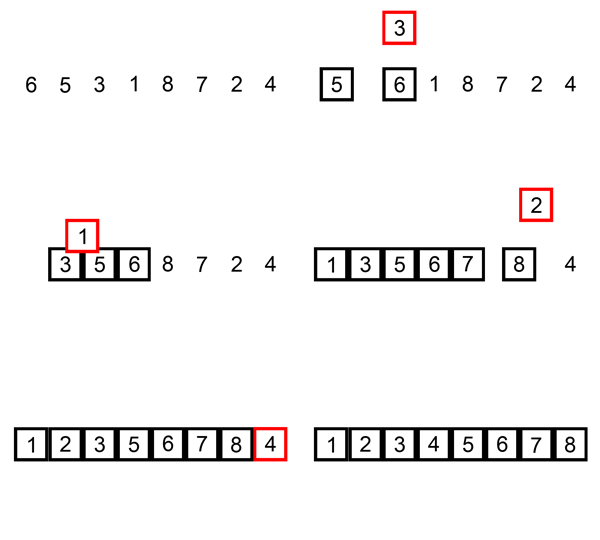
Insertion sort uses linear search to find the location of the 1st element in the unsorted list, in the sorted portion of the list. It is an elementary sorting algorithm best used to sort small data sets or insert a new element in the sorted list.

Algorithm:
Insertion sort starts with a sorted list of size 1 and inserts elements one at a time. It continues inserting each successive element into the sorted list so far.

  1. Suppose if the array is sorted till index i then we can sort the array till i+1 by inserting i+1th element in the correct position from 0 to i+1.
  2. The position at which (i+1)th element has to be inserted has to be found by iterating from 0 to i.
  3. As any array is sorted till 0th position (Single element is always sorted) and we know how to expand, we can sort the whole array.
for i ← 1 to length(A) - 1
    j ← i
    while j > 0 and A[j-1] > A[j]
        swap A[j] and A[j-1]
        j ← j - 1
    end while
end for
Insertion Sort Example

Property:
1. Best case performance – When the array is already sorted O(n). Total number of comparisons: N – 1 and total number of exchanges: N – 1.
2. Worst case performance – When the array is sorted in reverse order O(n2). N-1 iterations of comparison and exchanges.
3. Average case performance – O(n2)
4. It is sensitive to the input as the number of comparison and exchanges depends on the input.
5. It does not require any extra space for sorting, hence O(1) extra space.

Insertion Sort in Java :

import java.util.*;
import java.lang.*;
import java.io.*;

class InsertionSort
{
public static void main (String[] args) throws java.lang.Exception
{
int[] input = {4, 2, 9, 6, 23, 12, 34, 10, 5};
insertionSort(input);
}

private static void printNumbers( int[] input) {
for (int i = 0; i < input.length; i++) {
System.out.println( input[i] + “, “);
}
System.out.println(“\n”);
}

public static void insertionSort( int array[]) {

int n = array.length;
for(int j = 1; j < n ; j++) {
int key = array[j];
int i = j – 1;
while( (i> -1) && (array[i]) > key) {
array[i+1] = array[i];
i–;
}
array[i+1] = key;
printNumbers(array);
}
}
}

Link : Insertion-Sort-Algorithm

Binary Search Tree (BST)

A binary search tree is a node-based binary tree data structure where each node has a comparable key (and associated value ) and satisfies the restriction that the key in any node is larger than the key in all nodes in that node’s left  sub-tree and smaller than the key in all nodes in that node’s right sub-tree. Each non-leaf node has exactly two nodes. Each child must either a leaf node or the root of another binary tree. BST’s are also dynamic data structure and the size of a BST is only limited by the amount of free memory in the operating system.

The main advantages of binary search tree is that it remains ordered, which provide quicker search times  than many other data structure.

Binary Search Tree : A binary search tree of size 9 and depth 3, with root 8 and leaves 1, 4, 7 and 13


Properties of BST are following as :

  1. One node is designed the root of the tree.
  2. Each internal node  contains a key and has two sub-trees.
  3. Each sub-tree is itself a binary search tree.
  4. The leaves of the tree contain no key. Leaves are commonly represented by leaf or nil symbol, a Null pointer etc.
  5. The left sub-tree of a node contains only nodes with keys strictly less than node’s key.
  6. The right sub-tree of a node contains only nodes with keys strictly greater than the node’s key.

Time Complexity of BST in big O notation :

Average Worst case
Space O(n) O(n)
Search O(log n) O(n)
Insert O(log n) O(n)
Delete O(log n) O(n)

“The only way to do great work is to love what you do" – Steve Jobs

Design a site like this with WordPress.com
Get started